

The Print That Feels Like Your Original
You have spent hours perfecting your artwork. Every colour, every texture, every shadow is intentional. Then you get a print back and something feels off. The blacks look muddy. The gradients feel flat. The emotion is missing. This is the problem that pigment printing for artists was built to solve. With advanced archival inks and precision detail, artists can achieve rich tones, accurate colours, and long-lasting results through museum-grade art printing that preserves the true essence of every masterpiece.
What Is Pigment Printing?
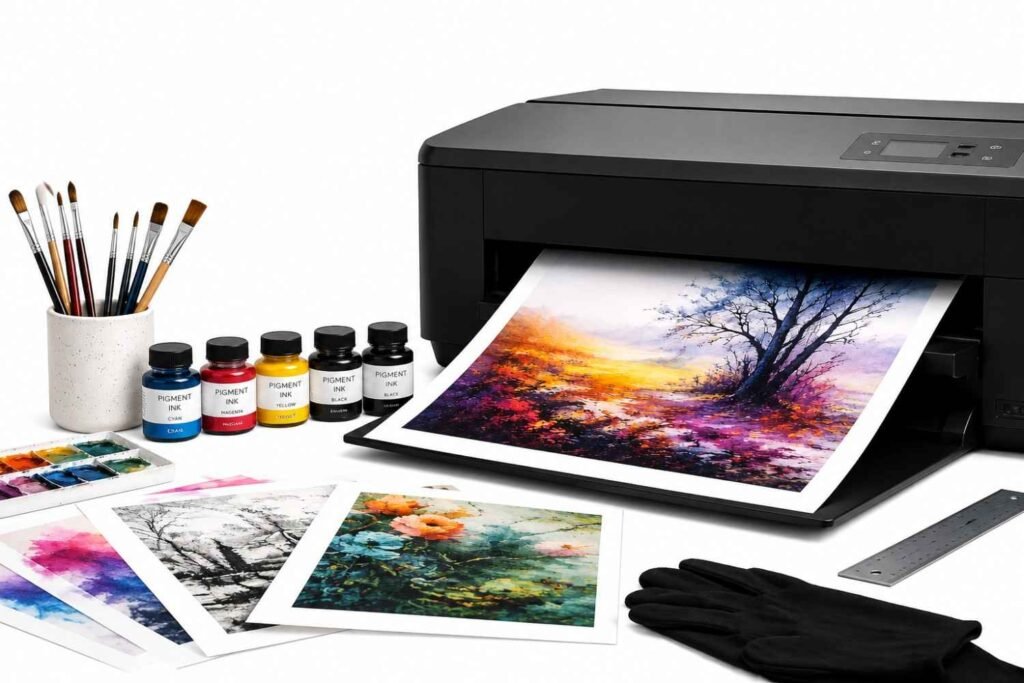
Pigment printing is a high-quality digital printing process that uses pigment-based inks rather than standard dye-based inks. These inks are applied onto fine art papers or canvas using professional archival printers capable of museum-grade reproduction.
The difference comes down to chemistry. Dye inks dissolve into liquid and can fade relatively quickly when exposed to light, humidity, or air. Pigment inks contain tiny solid particles that bind more stably to the paper surface, creating prints with:
- Superior UV resistance
- Deeper tonal range
- More accurate colour reproduction
- Stability that can last well over 100 years under proper conditions
That last point is not a marketing claim. It is why museums and galleries around the world specify archival pigment printing for their collections.
Why Artists Choose It Over Standard Printing
Most artists notice the difference emotionally before they can explain it technically.
A pigment print feels alive. Shadows hold their detail. Highlights stay delicate. The paper texture interacts with the image rather than sitting underneath it like a flat sheet of plastic.
- Fine art pigment printing also gives artists much greater control over how their work is experienced. Different paper surfaces create entirely different moods:
- Matte Cotton Rag brings a soft, painterly quality that suits watercolour and acrylic reproductions beautifully.
- Smooth Hot Press delivers clean precision for illustrations and detailed line work.
- Baryta Paper produces rich blacks and strong contrast, making it the favourite for fine art photography.
Fine Art Canvas gives prints a dimensional, gallery-ready presence that collectors respond to immediately.
Explore more – Fine Art Canvas VS Regular Canvas
The paper is not just a surface. It is part of the artwork itself.
Colour Accuracy: The Part Most Beginners Overlook
Here is something that surprises many artists printing their work for the first time: the colours on your screen are not the colours on your paper. Monitors emit light. The paper reflects it. Without professional colour management and calibration, prints can come out too warm, too dark, oversaturated, or oddly flat compared to what you designed.
A professional print studio handles this calibration as standard practice. Test prints are made. Profiles are adjusted. The goal is not just a technically accurate reproduction. It is a print that carries the same emotional weight as the original artwork.
This is where working with a skilled print partner makes a genuine difference, especially for artists printing editions for the first time.
Is Pigment Printing Worth It for Emerging Artists?
Many beginners assume fine art printing is only relevant once you are established. In reality, it matters most when you are building your reputation.
Presentation shapes perception. A collector looking at two similar works will always lean toward the piece that looks and feels considered, professional, and built to last. A beautifully produced pigment print communicates that the artist takes their work seriously.
It also protects your buyers. Collectors who know their prints will remain vibrant for decades are far more confident investing in your work.
A Few Mistakes to Avoid Early On
- Low resolution files are the most common issue. If your original artwork file is too small, enlarging it for print will reduce detail and sharpness noticeably.
- Over-saturated digital files are also common. Screens can display intensely vivid colours that simply cannot be replicated on paper. Pull back saturation slightly before sending files to print.
- Skipping test prints when ordering in quantity is a costly shortcut. Always proof on your chosen paper before committing to a full edition.
Your Artwork Deserves a Print That Lasts
A great print is not a copy of your artwork. It is your artwork, translated into a form that can travel into homes, galleries, and collections and stay beautiful for generations.
Pigment printing for artists is the standard that makes that possible.
At Photostop, we specialise in fine art pigment printing and archival pigment printing for artists at every stage of their journey. Whether you are printing your first edition or preparing work for an exhibition, we are here to make sure the print honours the art.
Explore our fine art printing services at Photostop.in